

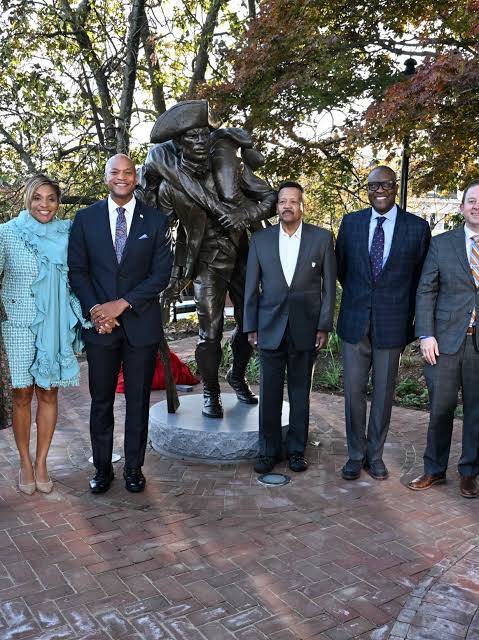
Yesterday, a new memorial honoring roughly 150 Black Marylanders who fought against the British during the Revolutionary War was unveiled on the grounds of the Maryland State House in Annapolis. The new memorial, “Black Patriots, The Pursuit of Transcendent Liberty,” commemorates free and enslaved Black soldiers who served the cause of American independence. In a fitting retraction, the new memorial stands on the same ground where a statue of U.S. Supreme Court Justice Roger B. Taney once stood.
Yesterday’s events reflect a broader trend in the United States to honor and memorialize Black service in the Revolutionary War. This recognition stems from a combination of factors that did not exist only twenty years ago. Today, historians, cultural institutions, and state governments across the country are deliberately pushing to more accurately honor and interpret Black soldiers in the Revolutionary War, both Black men who fought for the Patriots and the British. This push is inspired by a commitment to telling a fuller, more complete story of America’s founding. Another major inspiration is correcting centuries of purposeful historical omissions that suppressed this history. This history has always been there; however, no one looked for it.
An estimated 5,000 to 8,000 Black Patriots fought in the Continental Army during the war. Unlike European and British forces of the time, most Black soldiers fought in integrated Continental Army regiments. Initially, Washington banned enlistment of Black men in 1775 out of fear of slave rebellions and political resistance from the South. However, because of rampant manpower shortages, the ban was lifted. Black Patriots provided an essential manpower boost to Washington’s army, which struggled to recruit once the “spirit of 76” wore off. Most of these men served in direct combat roles. Outside the Continental Army, thousands more black men served as soldiers, laborers, and sailors. During the winter months of 1778, Black Patriots made up eleven percent of the soldiers in many regiments. In some brigades, Black soldiers made up over 30 percent of the active ranks. By the siege of Yorktown in 1781, French observer Baron de Closen estimated that the American army was roughly one-quarter black.
The unveiling ceremony occurred on the 162nd anniversary of the abolition of slavery in Maryland. The monument features bronze figures and a granite bench with “Acts of Agency,” which depicts free Black corporal Thomas Carney carrying his wounded commander, Major General Perry Benson, off the battlefield. Thomas Carney was a free Black Marylander born in either 1752 or 1754 on Maryland’s Eastern Shore. In May 1778, Carney joined the Continental Army, joining the Maryland Line and fighting at the Battle of Germantown and the Siege of Ninety Six in South Carolina. He was later promoted to Corporal, which made him one of the only known Black soldiers to hold that rank during the Revolutionary War. According to legend, Carney carried wounded Maj. Gen. Perry Benson off the battlefield and helped save his life. Canary received a pension for his service in 1818 and died in 1828. The monument also honors Black women who assisted the Patriot cause as laborers.
The State House Trust commissioned the monument in 2023 to mark the 250th anniversary of the Declaration of Independence. Steven X. Lee, an adjunct history professor at Stevenson University and founder of the Benjamin Banneker Historical Park and Museum in Baltimore County, initially proposed the project. The monument was made by California-based artist Branly Cadet. The unveiling marks the first addition to the State House grounds in nearly a century. The monument is also the first state capitol monument in the nation dedicated to Black Revolutionary War soldiers.
Add comment
Comments