

Written by Jon Acheson
An author bio follows at the end of the article
‘To the last Extremity’
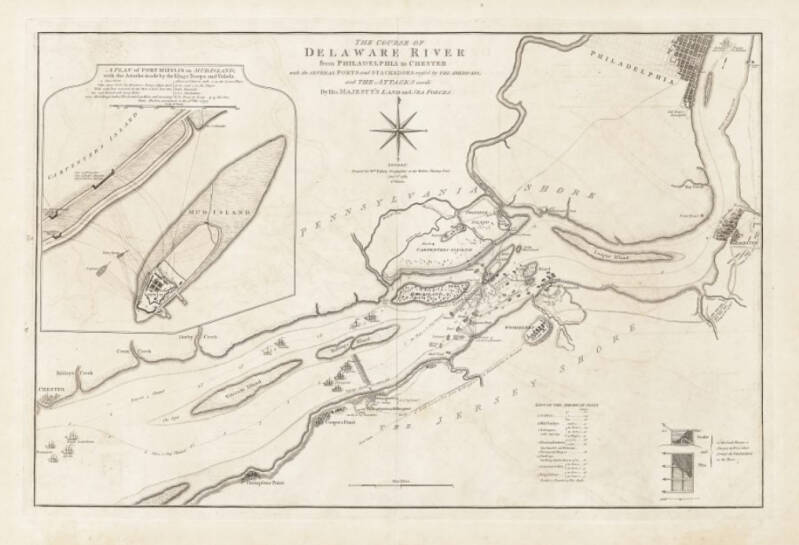
How did young Samuel Smith, a well-traveled heir to the wealthy merchant company Smith & Buchannan of Baltimore, end up on Mud Island that autumn attempting to hold the British at bay? What does this experience in the War of Independence tell us about revolutionary Maryland more broadly? It had been a great adventure, a fierce and inspiring seven weeks, but also a deadly and trying time: muddy, filthy, sleepless and dangerous, encumbered by a lack of resources and a petulant local naval commander employed by the state of Pennsylvania who refused to coordinate with Smith.1 Having held out against “one of the longest sieges and greatest bombardments” of the entire war, Smith’s defense of Fort Mifflin —the muddy 30 acre island below the confluence of the Schuylkill and Delaware rivers— had upended the expectations of British General William Howe to engage in continuous operations against Washington’s Continental Army on the run since their Brandywine Creek defeat.2
Howe’s victories in New York and Pennsylvania had so much encouraged the British General he thought perhaps the rebellion could be finished by the end of 1777. On October 4, trying to expand recruitment to the Loyalist side, General Howe in Philadelphia placed offers in the Pennsylvania Ledger luring rebel soldiers to switch sides: non-commissioned officers would receive 500 acres after the war, privates 50 acres.3 But the weeks-long tenacious resistance of both Fort Mercer and Fort Mifflin separated Howe from his navy, frustrated his plans, and slowed British momentum in the war.
In September 1777, Howe had captured Philadelphia by sailing up the Chesapeake side of the Delmarva peninsula, disembarking several thousand men and then outflanking Washington’s improvised defenses at Brandywine Creek. Though the strength of Patriot resistance and counterattack at Germantown surprised Cornwallis and Howe, by mid-September 1777 the American Continental Army was once again in retreat. Both New York and Philadelphia now lay in British hands. On September 23, General Washington ordered Smith away from his regiment in the Maryland Line to conduct a new “honorable command.” Gen. Washington, “The keeping of the fort [Mifflin] is of the greatest importance and I rely strongly on your prudence, spirit and bravery for a vigorous and persevering defence.”4 Washington did not hope to dislodge Howe from Philadelphia through force of arms, but rather, to prevent the Royal navy from re-supplying Howe’s army occupying America’s capital city. According to historian John Mass, the loss of Philadelphia meant, “Washington had been out generaled but given the size and condition of his army at the time, it is doubtful he could have prevented Howe’s success anyway.”5 What Washington could try to effectuate after the costly losses of Brandywine and Germantown was to block British passage to the port of Philadelphia up the Delaware River and so he called on the young Maryland officer to lead the effort.
Given this challenging assignment, Lt. Col. Smith’s personal reputation in the eyes of the growing Continental Army officer class rose because of his stubborn determination, promising Washington’s inner circle to “fight to the last extremity.”6 A few days after his arrival he conducted a successful raid on the British artillery position just south of the island, but Smith’s objective was straightforward: hold the island fort for as long as possible with portions of two depleted regiments and perhaps, with luck, long enough for the river to freeze over and both armies would retire to winter quarters.
In Smith’s two dozen letters from Mifflin to General Washington he pleaded repeatedly for more men and resources, “Without more Men in this Garrison I shall be able to do little. I have now in Garrison but 19 Serj'3 and 156 privates including the Militia, which are scarce more than Sufficient to work the Guns, your Excell': will see the Necessity of sending me more Men, at least 100.”7 Washington trusted the youthful Smith with this bare-bones strategic assignment in part because the General saw for himself from Brooklyn Heights the previous year —late August, 1776— what the men of the Maryland Line led by officers such as Smith had tried to do in their forward action on the American right to slow down General Henry Clinton’s grand, “hammer and anvil” destruction of the Continental Army. Suffering nearly 50% casualties, the Marylanders, including Smith’s men, were the very last to finally cross back over the East River to Manhattan after the Continental Army’s defeat on Long Island.8 Smith was among those Marylanders, yet again outnumbered, defending the heights above the Bronx River less than a month later, again allowing the main Patriot army to escape destruction.
Combined resistance of Mercer and Mifflin
Falling back on Fort Mercer was still an option for Smith and his men on Mud Island in early November because, as Friedrich von Münchhausen aide to General Howe, explains in his diary from the other side of the river, an offensive strike on October 22, had gone very badly for the British. An estimated 377 Hessians were killed or badly wounded storming the palisades of Ft. Mercer’s crude palisades under the command of Colonel Christopher Greene.9 This victory —Ft. Mercer’s miraculous survival— gave hope to Smith and the men of Fort Mifflin since they had been in near constant communication with Greene’s men, slipping back and forth across the water at night.
Captain Münchhausen in his diary compounds the bad news for the British from “up North”—that General Burgoyne’s invasion from Canada down the Hudson Valley had faltered—with bad news from the other side of the Delaware River. The failed assault by an entire Hessian Battalion to take “Red Bank” (Fort Mercer) killed several of von Münchhausen’s closest comrades: Colonel Donop, Lt. Col. von Shieck, and Col. von Minnigerode among others well known to him. Furthermore, the main assault of British naval forces up the Delaware on October 22-23, led by HMS Augusta to attack Fort Mifflin had also failed. Struck by cannon fire from Fort Mifflin, the Augusta blew up dramatically, its store of munitions completely detonating, rattling windows as far away as Philadelphia. On October 24, two days after the failed frontal assault on Mercer and the destruction of the sixty-four gun Augusta and two other ships by Smith’s men, Münchhausen wrote: “No one knows what we will do now; most are of the opinion that we simply must take Red Bank and Fort Island [Mifflin] as well as their ships in the Delaware in order to have communication with our fleet.”10
After the Hessian defeat at the Battle of Red Bank, new reinforcements finally arrived at Fort Mifflin. One of them was Private Joseph Plumb Martin, a Continental attached to a Connecticut regiment. From the moment he arrived in late October until the evacuation of the Garrison he wrote of near constant bombardment and repair work to the fortifications, “It was utterly impossible to lie down to get any rest or sleep on account of the mud, if the enemy’s shot would have suffered us to do so. Sometimes some of the men, when overcome with fatigue and want of sleep, would slip away into the barracks to catch a nap, but it seldom happened that they all came out again alive. I was in [Mud Island] a fortnight, and can say in sincerity that I never lay down to sleep a minute in all that time.”11
With fewer than two dozen working cannon of various sizes, including one 32-pounder for which they had no suitable cannon balls,12 Smith and his men had held out for over a month and repulsed the British effectively, just as Washington had hoped the young Marylander would. But their luck, of course, really couldn’t last if Howe and his staff, with greater resources, were equally resolved. Washington, nonetheless, so impressed by the survival of Fort Mercer and Fort Mifflin by the third week of October wrote to Congress recommending commendations. On November 4, 1777, Lt. Col Sam Smith was awarded an “elegant” gilded sword “as a testimony” for “gallantry.” The dress sword finally reached him a decade later.13
Smith at Fort Mifflin, Day 43:
Late afternoon on November 11 1777, Maryland’s Fourth Regiment commander, twenty-five year-old Lieutenant Colonel Sam Smith, wrote his last letter from Fort Mifflin in the middle of the Delaware River a few miles below Philadelphia, explaining his position to “His Excellency” General Washington. Under increasingly heavy bombardment, Smith suggested to his commander it may finally be time to abandon the fort. But Smith thought the larger objective to block the British navy from achieving direct connection to the port of Philadelphia might continue from Fort Mercer on the New Jersey side of the river. “I am of opinion [the defense of the river] could be done nearly as well from the other Shore as from this fort had they our Cannon.” 14 Known by locals as Mud Island, conditions on Ft. Mifflin on the 43rd day of Smith’s command was dire.
The bombardment of Fort Mifflin had grown particularly intense because on November 3, the British Navy finally managed to cross one of two enormous, submerged iron and wood beam barriers called trident spikes. They were linked together by iron chains and were set in weighted boxes called “chevaux-de-frise”.15 Able to bear down just a few hundred yards away from the fort, the British mercilessly pounded Mifflin’s breastworks and block houses from both land and water using newly constructed floating gun platforms. By the beginning of November, the weeks of work to improve the fort’s defenses were collapsing.
On November 11, Smith estimated the current rate of destruction and wrote presciently to Washington: “in 5 or 6 days unless the siege can be rais’d the fort will be laid open and everything destroy’d if they Continue to Cannonade and bombard as they have done. Our Men already half jaded to Death with Constant fatigues will be unfit for service.”16The situation was indeed desperate. However, Smith never finished his November 11 letter to Washington. During his rounds Lt. Col. Smith was handed another message, this time from Rhode Island’s General Varnum in New Jersey. Smith went back into the central block house to respond to Varnum and complete his correspondence to Washington when he was interrupted by an explosion. A British cannon ball, having demolished the chimney behind him, sent a shower of bricks and mortar into the quarters. The iron ball itself came to a rest only after striking Smith in the left hip and crushing his wrist. Half-buried in rubble, momentarily knocked unconscious, he regained his wits and, along with a handful of other stunned soldiers, crawled to an open doorway for air. He was badly bruised and likely severely concussed, but alive.17 Within a few hours, after being bandaged and bled by the camp physician, the young Lieutenant Colonel came to the realization that his command of Fort Mifflin had come to an end.
Mud Island’s intrepid defense in the autumn of 1777 quickly turned into a story of bravery and survival among the Patriots and became a substantial annoyance for the British commanders. Hessian officer Friedrich von Münchhausen, overseeing the movement of shore artillery units battering low-lying Fort Mifflin, wrote in his diary: “Cannonading and bomb-throwing continues day and night. I wish we would finally capture this cursed fort; it makes us aides ride around so much…one is exposed to enemy shells.”18
This Patriot tenacity is reflected once again in the last letter of November 11 from Smith to Washington, “we will replace at Night such [defense works] as are destroy’d by Day & endeavour to keep the fort as long as in our power, as the principal object I presume of your Excelly is to hinder the enemy from raising the Chevaux de Frise.” But as Smith explains as the bombardment becomes incessant, soon it may be time to, “destroy the whole works [at Fort Mifflin] and take the Guns to the Jersey Shore where they might serve to guard the River.”19
The fall of Mud Island
Late in the evening of November 11, Smith turned command of Fort Mifflin over to Major Francois-Louis Teissedre de Fleury, and his new friend, Major Simeon Thayer of Rhode Island. Smith’s elder by fifteen years, Thayer was a highly experienced officer whom Smith looked up to despite Thayer’s inferior rank. Smith trusted Major Thayer would make the right decision about when to withdraw without losing the remaining men.20 Smith also bid farewell to several dozen fellow Marylanders, and others, mainly Continentals from Virginia and Connecticut regiments, as well as Pennsylvania militia. De Fleury, assigned to Smith for the special defensive operation in September by General Washington, was an excellent military engineer and had helped rally the men each evening to rebuild what had been destroyed in the final days of bombardment. Military records suggest over a thousand shells landed each day on the island’s defenses from November 10 -15.21
On that fateful night of November 11, 1777, having boarded one of the small craft soldiers of Mud Island were using to slip out at night across the water for intelligence, to send messages, and retrieve supplies, Smith finally reached Colonel Greene’s patriot-held Fort Mercer safely. Over the next few hours he watched as the bombardment of Mifflin grew even more intense. Major de Fleury was struck three days after Smith turned over command to him but unlike Smith, the beam and brickwork that fell on de Fleury killed him outright.
The British flotilla had made its way further up river. On November 15, Smith and other officers observed from the western wall of Fort Mercer that British naval sharpshooters were close enough from their perches on the rigging of ships near Mud Island to aim downward into the fort at anything that moved. “There was a ferocious cannonade” one Hessian officer wrote. “All [the Patriots] mounted batteries, cannons of the largest caliber, were not only dismounted, but buried in the rubble…blood, brains, arms, legs, everything lay about.”22 Smith knew Thayer and the remainder of Fort Mifflin’s defenders would have to set fire to whatever they could, spike guns they couldn’t transport, destroy munitions, and flee the fort as quickly as possible for the “Jersey Shore.” The British found almost nothing of use when they finally landed on the island. “Colonel Osborn took possession of the island…and found nothing but a charred camp and bloodstains,” wrote one Redcoat.23
On November 17th Smith bought a horse and rode north to White Marsh, Pennsylvania and Washington’s camp. He was greeted as the Hero of Mud Island and General Washington, though disappointed that the Fort had fallen, wrote to Congress, its “defence…[was] a credit to the American arms [which] will ever reflect the highest honor upon the officers and men of the Garrison.”24
Revolutionary Legacy
Unlike other notable Maryland Line officers such as William Smallwood and Mordecai Gist, Sam Smith did not fight in the 1779-1781 southern campaigns at all. Less than a month after Fort Mifflin’s fall, Smith retreated to Baltimore where he got married, redeemed his father’s failing business, and recruited more Continentals to replenish Maryland’s contribution of soldiers to the war. Smith marched fresh men north to Valley Forge in the spring of 1778 but after the Battle of Monmouth in New Jersey in June, 1778, Smith saw no more action in the Revolution.
Gen. Washington in the summer of 1778 and the Marquis de LaFayette in early 1779 both offered Smith aide de camp positions which he turned down.25 Sam Smith resigned his commission in the Continental Army in May 1779 writing to Washington of his deep regret. Smith apparently had settled into the life of a successful Baltimore merchant and married man. It would take an assault 35 years later on his own hometown in 1814 to get the soldier back in the field of battle. But long before he was known as the Hero of Baltimore, the young revolutionary Sam Smith was the “Hero of Mud Island,” an intrepid Maryland commander willing to engage in a grueling duel of artillery fire for seven weeks against a much larger force in order to slow down and exhaust British efforts to consolidate their hold in the mid-Atlantic during the Revolutionary War.
Endnotes
- Frank Cassell, Merchant Congressman in the Young Republic, (1971), 25-7; Patrick O’Donnell, Washington’s Immortals…, (2016), 165.
- Cassell, 22; O’Donnell, 163-64.
- Christopher M. New, Maryland Loyalists in the Revolution, (2009), 44.
- The Papers of George Washington, Revolutionary War Series, vol. 11, August 19, 1777 – October 25, 1777, ed. Philander D. Chase and Edward G. Lengel, (University Press of Virginia, 2001), 308; “George Washington to Lieutenant Colonel Samuel Smith, September 23, 1777,” Founders Online, National Archives, https://founders.archives.gov/documents/Washington/03-11-02-0312.
- John R. Maass, From Trenton to Yorktown, (2025), 110.
- Smith to General Washington, October 30, 1777, Smith Papers, Box 3, Maryland Center for History and Culture.
- Smith to Washington, October 14, 1777, Smith Papers, Box 3, Maryland Center for History and Culture.
- O’Donnell, 159.
- “The Battle of Red Bank,” https://www.gloucestercountynj.gov/671/Red-Bank-Battlefield.
- Frederich Von Münchhausen, At General Howe's side, 1776-1778: the diary of General William Howe's aide de camp, Captain Friedrich von Meunchhausen, (Philip Freneau Press, 1974), 43.
- Joseph Plumb Martin, Memoir of a Revolutionary Soldier, (2006), 55. https://archive.org/details/memoir-of-a-revolutionary-soldier-by-joseph-plumb-martin-2006/page/n55/mode/1up.
- Plumb, 56.
- Cassell, 28.
- Smith to Washington, November 11, 1777, Smith Papers, Box 3, Maryland Center for History and Culture.
- Jeanne Willoz-Egnor, “Frames of Destruction,” (October 2012), https://www.marinersmuseum.org/2021/10/frames-of-destruction/.
- Smith to Washington, November 11, 1777; Maryland History Magazine , V, no.3, 1910, 228.
- Cassell, 30.
- At General Howe’s side, 1776-1778: the diary of General William Howe’s aide de camp, Captain Friedrich von Meunchhausen, (Philip Freneau Press, 1974), 43.
- Smith to Washington, November 11, 1777, Smith Papers..
- Edwin Martin Stone, The Invasion Of Canada In 1775: Including The Journal Of Captain Simeon Thayer, Describing The Perils And Sufferings Of The Army Under Colonel Benedict Arnold, (1867), 231-4.
- O’Donnell, 170.
- O’Donnell, 172.
- O’Donnell, 173.
- Cassell, 31.
- Cassell, 34
Author Bio - Having taught history and literature for 39 years in various secondary and adult education classrooms in the USA and abroad, Jon Acheson, in retirement, sails in the Chesapeake Bay, travels, and writes. A longtime resident of Baltimore, he is the author of “Charles Dickens, The Baltimore Letters” Maryland Historical Magazine, Winter 2007, Vol. 102, No. 4 addressing the personal and political issues Dickens experienced on his first tour of America, March, 1842.
Add comment
Comments