

Written by Drew Palmer
An often understudied period of the American Revolutionary War is the period between the British surrender at Yorktown in April 1781 and the ratification of the Treaty of Paris in September 1783. Histories of the Revolutionary War have paid limited attention to this period; there are few heroic stories, romanticized battles, or conflict-altering events. However, truly understanding the Revolutionary War in its full scope requires attention to this relevant period. As the armies waited for a peace treaty, both sides remained idle, keeping a watchful eye on each other while remaining largely defensive. For the state of Maryland, this period was filled with challenges, one of which was the administration of undersupplied and underfunded prisoner-of-war camps throughout Maryland. In Frederick, Maryland, a large contingent of Hessian troops was imprisoned. Their confinement was uncomfortable and in many cases, deadly. However, the Hessians' time in captivity was unique; many chose to stay in the Frederick area after their release and became active participants in Western Maryland's society and economy.
After Gen. Charles Cornwallis’s disastrous defeat at Yorktown, Virginia, in 1781, he attempted to negotiate paroles for the thousands of men in his army. However, Gen. George Washington rejected Cornwallis’s request for parole and ordered that the men of Cornwallis’s army must surrender. 1 After the official surrender ceremony, thousands of British and Hessian troops awaited their fate. It was decided to divide the prisoners into two groups. After the division occurred, they were marched to prison camps throughout the north. The capitulation documents ordered the prisoners to be sent to Maryland, Pennsylvania, or Virginia. 2
Among the three states, Winchester, Virginia, and Frederick, Maryland, were considered ideal places to house prisoners of war. Frederick was relatively remote and considered a part of the “back country” and was mostly agricultural. 3 Frederick was also considered far enough from the main theaters of war to be considered safe from British rescue attempts. Continental and state leaders had hoped that Frederick’s large population of German immigrants would help Hessian prisoners integrate into society, thereby reducing the cost of feeding and guarding them.4 The first group of prisoners was sent to prison camps in Winchester, while the second group was sent to Frederick.
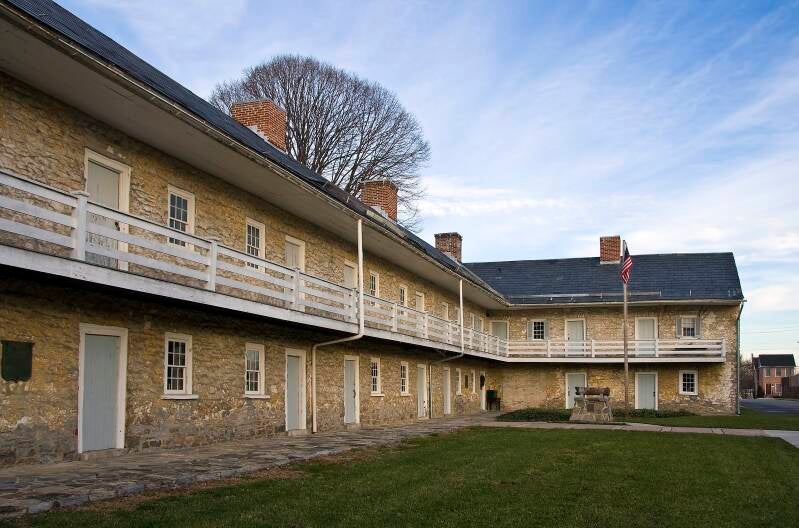
Conditions in Winchester quickly deteriorated after the first group of prisoners arrived in Winchester, Virginia, prompting Washington to send the first group of prisoners to Maryland, specifically Frederick. Most of the British prisoners within the first group went to Lancaster, Pennsylvania, while the Hessians joined the second division of Hessian prisoners already in Frederick. Though records are unclear about the exact number of Hessian prisoners in Frederick, there were likely around 1,500 prisoners in and around Frederick by late winter 1782. 5 Maryland was overwhelmed by the number of Hessian prisoners and used any empty structures they could to house them. One of the structures used most in Frederick was a series of abandoned barracks, which became known as the Hessian Barracks.
Life in Captivity at the Hessian Barracks at Frederick
The second group of prisoners had already been at the Hessian barracks for weeks before Private Johann Conrad Dohla arrived with the first group of prisoners from Winchester. Dohla was surrendered with Cornwallis’s army at Yorktown and endured the horrible conditions of the prison camp in Winchester. In comparison to Winchester, Dohla described the town of Frederick as,
"A beautiful, fertile, and pleasant region, partially in a valley; however, when it rains, it becomes muddy because the city is still not paved. It is heavily settled by Germans, of whom many are from Swabia. This city was first laid out sixteen years ago, but already has nearly two thousand inhabitants, has several good houses, and makes a show with several steeples. The streets of the city are laid out evenly, to the four corners of the world. A few houses are of wood, most of limestone and brick, both building materials that are baked and prepared here. The inhabitants carry on handcrafts and agriculture. There is no navigable water in the vicinity; therefore, this place has no important trade to brag about. The Monocacy, a small river four miles north of here, is too small; and the Potomac, eight miles south, is unnavigable in this region because of the nearby falls".6
Dohla was sent to the Hessian Barracks south of Frederick in early 1782. The barracks were originally built in 1777 to house Maryland volunteers and later used to house Hessian and British prisoners. The barracks consisted of two L-shaped two-story stone structures. The short ends of the L’s faced one another, forming a courtyard in between the two structures. The rooms were rectangular in shape and plain. There was no interior passageway, and the walls between every two rooms had fireplaces.7 There were two wooden staircases that connected the first and second stories. 8 Dohla described the barracks' appearance, stating they were “two stories high, built of stone, and have a regular roof. The company received two floors, one upper and one lower for quarters. It was very cold and drafty in our quarters.” 9
Though Dohla initially commented on the serenity and positive perception of Fredrick, living as a prisoner at the barracks was an uncomfortable existence. Sickness and poor conditions were all too common in the Hessian Barracks, and the winter months of 1782 were cold and uncomfortable. 10 Bugs, lice, and worn-down, tattered clothing made for a nagging discomfort that persisted throughout the barracks' use as a prison. Regardless of the season, sickness was present. In the winter and summer months, it was not uncommon for Hessian prisoners to die every week, usually at the field hospital, which was near the Hessian Barracks. 11 In early April, Dohla became severely ill. At the same time, Dohla commented on his frustrations with conditions, writing that, “there were many sick in our two regiments, and half of our company was down sick, most with high fevers, chills, and putrid fever. At present, we receive poor rations, raw bread, almost rotten and stinking, salted meat, and occasionally stinking herring fish. Many of us prisoners went barefoot and half-naked; most no longer had a shirt on their bodies, and many [went] with only a rag, which was full of bugs. What else could we do, as our baggage, which should have come long ago, remained unavailable.” 12 Dohla became dangerously ill once again in May, when he could barely walk. 13 The poor conditions at the barracks were rooted in the all-too-common issue of limited American supplies and resources. The Hessians were prisoners belonging to the Continent, meaning prisoners captured by the Continental army. However, the enormous task of guarding and caring for the prisoners in Frederick fell to the Maryland militia, who did not have the resources, money, or men to adequately care for and guard the Hessians.14 Complicating matters further was that the state of Maryland was paying for the care of the Hessian prisoners without any financial or logistical support from Congress. 15 This reality was causing Dohla and the other prisoners immense hardships.
Stephan Popp, a corporal in the Second Battalion of the Ansbach- Bayreuth Regiment, arrived at the Frederick Barracks in January 1782 and described similar discomforts as Dohla. Popp was particularly uneasy about the cramped conditions of the barracks. Popp wrote that the barracks accommodated forty-six men of his company in one room, making it difficult to keep the quarters clean due to overcrowding. Popp and Dohla agree that the lack of clothing and provisions persisted until supplies arrived in late April 1782, providing some reprieve. 16
The Maryland Council of Safety was well aware of the lack of structure and resources at the Frederick Barracks; yet, nothing could be done. The Council wrote of the concerns, quoting a major in the Maryland militia,
"I am really under a great deal of uneasiness about at the situation of the prisoners. I meet with every obstruction in the execution of my duty, and am obliged to be very mild with prisoners for fear of disagreeable consequences, and without a stronger guard, the prisoners will be scattered all over the country; the farmers are full of complaints about the destruction of their property, which I cannot prevent. This will show you the present situation of the prisoners at Frederick Town, and we hope, will fully justify you for departing so far from your instructions as to furnish a regular guard of 100 men."17
There were only around seventy-five militiamen from Baltimore County tasked with guarding the Hessians. At one point, there were only twenty-five militiamen guarding the Hessian Barracks, making manpower a major concern. 18 An equal concern directly affecting Dohla and the prisoners was the state of Maryland's lack of money to pay for supplies and provisions. The Council stated to the Congress that due to “the exhausted situation of this state, it is not within the compass of our abilities to subsist the prisoners quartered upon us.” The Council asserted that the militia could not guard prisoners unless Congress provided funding. The Council wrote, “We have therefore and most earnestly request and most earnestly entreat that you will furnish us immediately with a Sum of Specie, or we cannot be answerable to the consequences. It is necessary that we have $20,000 in the course of the winter, perhaps four or five thousand will would answer our present occasions.” 19 At the center of the conundrum was the fact that Maryland shouldn’t have been taking on this responsibility by itself. The Council wrote the Continental Army that,
"The prisoners are Continental prisoners and ought to be guarded by the Continent. The expense of turning out the militia for this service is really enormous. To keep a guard of 200 men at Frederick Town, which must be relieved every two months, it is indispensably necessary to have 400 men continually in motion and in pay, one half the time of each class being consumed in making preparations and marching and returning; to say nothing about the loss of so much useful labour, and the great aversion to our people to this kind of duty."20
Even with the council’s pleas for provisions and financial aid, their calls fell on deaf ears as Congress’s responsibilities were already stretched thin; Maryland and the militia were told not to expect help. Lacking money, Maryland was unable to provide provisions and clothing such as pork, beef, firewood, flour, shoes, or blankets. 21 The Hessians had to wait five months for their back pay and supplies to arrive in April; yet supply issues persisted throughout their time in captivity. 22 It wasn't until November 1782 that a small contingent of Continental troops was sent to Frederick to help guard prisoners. 23
Amongst the many challenges that the Hessians faced while in captivity, the regiments attempted to retain structure and normalcy while in the barracks. Religion was the primary way Hessians in captivity maintained a routine outside their work. Communions, church ceremonies, and religious gatherings were very common. 24 When soldiers could not attend religious gatherings in person, they often looked inwards for their faith in trying times to thank God for positive outcomes and occurrences. 25 The Hessian prisoners understood they were not normal prisoners; they were often able to participate in organized religion outside the barracks on German farms while remaining out of sight of American guards. 26
The Hessians' unique imprisonment in the Hessian barracks allowed many to exercise their personal agency to improve their lives, especially as conditions and supply issues worsened in 1782. As stated previously in the article, one of the reasons Frederick was picked for a prison camp was due to the large German population in the area.27 The hope was that the prisoners would use the region's abundant agriculture to feed themselves, given the supply issues the state of Maryland predicted in 1781. Many Hessians were granted permission to work temporarily on local farms and often had free range of the town during the day. 28 Popp also described how he and his fellow prisoners “were left quite free.” 29 The unusual freedom they received as prisoners created problems, though. Some Hessians were found working in Frederick, having not reported to the prison their absence, while others were found drunk in the streets. 30 Dohla reported in May that many Hessians simply left for the country and did not return.31 In some instances, violence followed Hessian escape attempts. Johann Ernst Prechtel of the Bayreuth regiment reported that “ private Gaertner, of the von Seybothen Regiment, was captured today by an American patrol in the city [Frederick], and as he tried to flee, was shot through the body.” 32 Some soldiers attempted to barter their way out of captivity; some were successful, while others were found and returned to the barracks. 33 It became clear that the American militia had very little control over the Hessians.
In June 1782, Congress attempted to regain control of Hessian prisoners throughout the United States. The citizens of Frederick received an order stating that citizens caught supporting or providing quarters for prisoners of war could face a fine of five hundred pounds or three years as a sailor on an American ship.34 In September 1782, the Congress continued to strengthen prison rules while also creating ways for prisoners to buy their freedom and swear their allegiance to the United States in a controlled and official manner,
"From September 1 on, all of the captives from Cornwallis’s army who had worked here and there in the country had to return to their regiments and enter the barracks, by an order of the Congress at Philadelphia. Also, all of the captives from Burgoyne’s army who were scattered in the land, were assembled. However, anyone of them who was married to an American woman was released again for a fixed sum, and could again depart; [the same was] also [true of] many who had sworn allegiance to America. All of us captives had permission from Congress to swear our allegiance. Also, for thirty pounds, that is, eighty Spanish dollars, it was possible to buy freedom out of captivity, or to allow an inhabitant to buy our freedom, and we could work off the indebtedness. This order was publicly proclaimed, posted, and read in the churches. Also, the recruiting for the American Continentals, or regular troops, was carried on here in Frederick, and the recruiters were permitted to enter our barracks. They promised thirty Spanish dollars bounty money, of which the recruit received eight dollars as soon as he was engaged and the remainder when he arrived at his regiment. Permission to enlist was only applicable to the German troops. The English were not allowed to enlist or engage."35
Congress also authorized that Hessian prisoners could join the Continental Army. Based on recollections from Dohla and Prechtel, a sizable minority of men took this offer. On September 21, Prechtel wrote that twenty-four men from the Hessian regiments in captivity in Frederick left on an American recruit transport to join the Continental Army.36 Another recruit transport left with twenty Hessians, days later en route to their new American units.37 Dohla describes the recruiting efforts at the Hessian Barracks, saying that, “the recruiting for the American Continentals, or regular troops, was carried on here in Frederick, and the recruiters were permitted to enter our barracks. They promised thirty Spanish dollars bounty money, of which the recruit received eight dollars as soon as he was engaged and the remainder when he arrived at his regiment. Permission to enlist was only applicable to the German troops. The English were not allowed to enlist or engage.” 38 The American recruiters often brought music and young women in an attempt to enlist as many Hessian prisoners as possible. These spirited attempts at recruitment often created disorder in the crowded barracks. Though he doesn't write about it, Dohla wrote in his diary that Popp was stabbed in the head by an American guard's bayonet “because of the trouble created in the barracks.” 39 There are no records indicating why these men chose to join Continental units, but based on the Hessians' experience in Frederick, it is likely they were attracted by the pay bounty and opportunity to be free men.
As the months dragged on, summer brought more sickness, desertions, and uncertainty about the Hessians' future. By April 1783, Congress had finally resolved to arrange the liberation of all Hessian prisoners in the United States. When the news broke of a peace treaty between England and the United States, Popp could hardly believe it until locals confirmed it. 40 Dohla describes the events preceding the news of the surrender in greater detail, writing that,
"Thereupon, a peace-celebration bonfire was built by the regular troops and the militiamen stationed here, and they paraded behind the resounding sounds of fifes and drums through all of the streets and ways of this place with white flags, green caps, and laurel wreaths on their heads, and firing their weapons. With each volley, old and young gave an extraordinarily loud cheer: ,Hyroh for peace! Hyroh for the liberty! Hurrah for Washington! Hurrah for Congress! For Hancock! For ourselves! God save the General Washington, our Master!“ An 18-pound cannon was brought here also, and this was fired more than thirty times from a height before the city. At night a beautiful fireworks display took place, which was prepared for the Americans by our Artillery Captain [Nikolaus Friedrich] Hofmann and his artificers and cannoneers, for pay. It was very beautiful to see." 41
Dohla and his counterparts had endured fifteen and a half months of captivity, some even longer. 42 Conrad Dohla returned home to the Ansbach Bayreuth region after his release from prison, following most of his comrades back to Europe. Though many Hessians returned to their homeland, many stayed in Western Maryland and carved out new lives for themselves in the Frederick region.43 Most were attracted to the opportunity for a new life and the availability of land. Also, a motivating factor was the area's German population, which shared the language and culture of the former Hessian troops. The Hessians who chose to stay mostly settled in the Lewistown area, only a few minutes north of Frederick.44 Other Hessians settled in surrounding communities throughout Maryland, Virginia, and Pennsylvania.
Adam Shawbaker surrendered to Continental forces at the Battle of Yorktown in 1781. He was brought to the Hessian Barracks and imprisoned until 1783. He paid eighty-three Spanish American dollars to gain his release and decided to stay in the area. Shawbaker earned money during his imprisonment by working with local German farming families. Adam met Anna Barbara Schnautiegel and married her in 1787; the couple settled in Frederick. The two had four children and eventually moved to the Middletown area. 45 Adam’s son, George, served in the Maryland 3rd Militia Regiment in 1814 during the War of 1812. After the war, George and his wife Matilda had seven children. 46
Johann Henry Frolich [anglicized to Fraley] was a Hessian drummer imprisoned at the Hessian Barracks after being surrendered at Yorktown in 1781. After the war's end, Fraley, like many other Hessians, decided to start a new life in the Frederick area. Eventually, Fraley found employment at the nearby Catoctin Furnace and lived in Furnace Village until his death in 1830. Fraley had fourteen children and became a U.S. citizen in 1796. By 1811, he owned multiple acres in the Catoctin area. His son and grandson, Solomon, also worked at Catoctin Furnace. The Fraley family is one of the many families descended from Hessians who created thriving businesses in the community. 47
Some Hessians stayed in the United States but left the Frederick Area. Jacob Ruehrschneck was a prisoner at the Hessan Barracks. Though the records aren't entirely clear on how Ruehrschneck left the Hessian Barracks, he appears to be present and accounted for in Frederick from early winter 1782 to the Hessians' release in spring 1783. It is likely that Reuhrschneck left the Hessian column as it marched to New York to return to Europe, instead choosing to stay in the new United States. Ruehrschneck settled in Shenandoah Valley in Virginia. Records also show that Ruehrschneck returned to Frederick for around five months. He returned to Virginia and settled down on the Koontz farm, working as a farmer. 48
Most Hessian veterans became local farmers and tenant laborers, purchasing small plots and living quiet rural lives. 49 Others benefitted from skills learned in the military and before the war to become artisans, working as blacksmiths, weavers, shoemakers, and carpenters. 50
From staying in the Frederick area, the Hessian veterans helped to strengthen already thriving German communities.
The experience of the Hessian prisoners in Frederick, along with the challenges the state of Maryland had in garrisoning and adequately provisioning the prisoners, highlights the complexity of the conflict once major hostilities ended. States such as Maryland were tasked by Congress with the care and security of thousands of prisoners, but they did not have the money, men, or provisions to ensure their comfort or the security of the prison. Tragically, the Hessian prisoners were left to endure poor and crowded conditions with limited provisions, causing sickness and disease to spread. Nevertheless, the prisoners at the Hessian barracks were not average prisoners and had limited freedoms to make money and survive. Seeing the possibility of a new and better life during their time in Frederick, many Hessian prisoners chose to stay in the area after peace was declared, helping to strengthen the vast German communities there. Though the Revolutionary War will always be remembered primarily for its large battles, world-altering events, and documents, the story of the Hessian Barracks, the men who were there, and the challenges they faced adds depth to our understanding of the period and illuminates ordinary human experiences that shaped Maryland’s Revolutionary story.
Endnotes
- Founders Online, George Washington Papers, October 1781, https://founders.archives.gov/documents/Washington/01-03-02-0007-0006.
- National Park Service, “History of the Siege,” Yorktown Battlefield — Colonial National Historical Park, https://www.nps.gov/york/learn/historyculture/history-of-the-siege.htm.
- P. Kirby Gull, A Captor’s Conundrum: The Management of German Prisoners After Yorktown, A Maryland Perspective, Journal of The Johannes Schwalm Historical Association, Vol. 7, No. 3, 2003. 34.
- Gull, A Captor’s Conundrum, 34.
- Historical Marker Database, Frederick Town Barracks , https://www.hmdb.org/m.asp?m=103418.
- Johann Conrad Döhla, A Hessian Diary of the American Revolution, trans. and ed. Bruce E. Burgoyne (University of Oklahoma Press, 1990), 122.
- Hessian Barracks, National Register of Historic Places Inventory — Nomination Form, NR-44 (Frederick, MD: Maryland Historical Trust, 1970), PDF, https://apps.mht.maryland.gov/medusa/PDF/NR_PDFs/NR-44.pdf.
- Hessian Barracks, National Register of Historic Places Inventory — Nomination Form, NR-44 (Frederick, MD: Maryland Historical Trust, 1970), PDF, https://apps.mht.maryland.gov/medusa/PDF/NR_PDFs/NR-44.pdf.
- Dohla, Hessian Diary, 122.
- Dohla, Hessian Diary, 123.
- Dohla, 123. Popp, Dohla, and Prechtel note in their diaries when soldiers died. At its worst, soldiers were dying every week and sometimes multiple in the matter of days. The spring season seemed to offer the most reprieve from sickness.
- Dohla, Hessian Diary, 125.
- Dohla, 126.
- Council to General Smallwood, April 16, 1782, Archives of Maryland, 138.
- Council to Robert Morris , December 14, 1781, Journal and Correspondence of the State Council, 1781–November 11, 1784, Archives of Maryland, vol. 48, ed. J. Hall Pleasants (Annapolis: Maryland Historical Society, 1931), 24.
- Popp, Popp’s Journal, 26.
- Council to General Smallwood, April 16 1782, Archives of Maryland, 140.
- Council to Colonel Phillip Thomas, April, 5, 1782, Archives of Maryland, 121.
- Council to Robert Morris, December 14 1782, Archives of Maryland, 24.
- Council to General Smallwood, April 15, 1782, Archives of Maryland, 138.
- Gull, A Captor’s Conundrum, 58.
- Dohla, Hessian Diary, 125.
- Dohla, 131.
- Dohla, 135. Dohla, Popp, and Prechtel list religious gatherings throughout their diaries. These gatherings were often led by the regimental chaplain.
- Dohla, 126.
- Popp, Popp’s Journal, 27.
- Bruce E. Burgoyne, A Hessian Officer’s Diary of the American Revolution: Translated from an Anonymous Ansbach-Bayreuth Diary and the Prechtel Diary (Westminster, MD: Heritage Books, 1993), 236.
- Dohla, Hessian Diary, 126.
- Popp, Popp’s Journal, 27.
- Dohla, 125.
- Dohla,125-26.
- Burgoyne, A Hessian Officer’s Diary, 241.
- Dohla, 127.
- Burgoyne, A Hessian Officer’s Diary, 240.
- Dohla, Hessian Diary, 129.
- Burgoyne, 243.
- Burgoyne, 244.
- Dohla, Hessian Diary, 129.
- Dohla, 129.
- Popp, Popp’s Journal, 27.
- Dohla, Hessian Diary, 135.
- Dohla, 135.
- Thomas John Chew Williams, Folger McKinsey, History of Frederick County, Maryland: From the Earliest Settlements to the Beginning of the War Between the States, vol. 1 (L.R. Titsworth & Co., 1910), 443.
- Thomas John Chew Williams and Folger McKinsey, History of Frederick County, Maryland, 343.
- Chris Haugh, “A Hessian Connection,” Stories in Stone Blog, Mount Olivet History, http://www.mountolivethistory.com/stories-in-stone-blog/a-hessian-connection.
- Chris Haugh, “A Hessian Connection,” Stories in Stone Blog, Mount Olivet History, http://www.mountolivethistory.com/stories-in-stone-blog/a-hessian-connection.
- Frederick County Historic Preservation Commission, County Register Nomination Staff Report: F.W. Fraley General Merchandise Store (CR 24-01) ( Frederick County Government, 2024), 3. https://www.frederickcountymd.gov/ArchiveCenter/ViewFile/Item/ Shenandoah15013.
- “Jacob Ruehrschneck,” Fold3, accessed Feb 4, 2026, https://www.fold3.com/memorial/653592441/jacob-ruehrschneck.
- Dohla, Hessian Diary, 136.
50. City of Frederick, Maryland, Overview: History of Frederick ( City of Frederick, n.d.), 9. https://www.cityoffrederickmd.gov/DocumentCenter/View/509/Overview-History-of-Frederick.
Add comment
Comments